
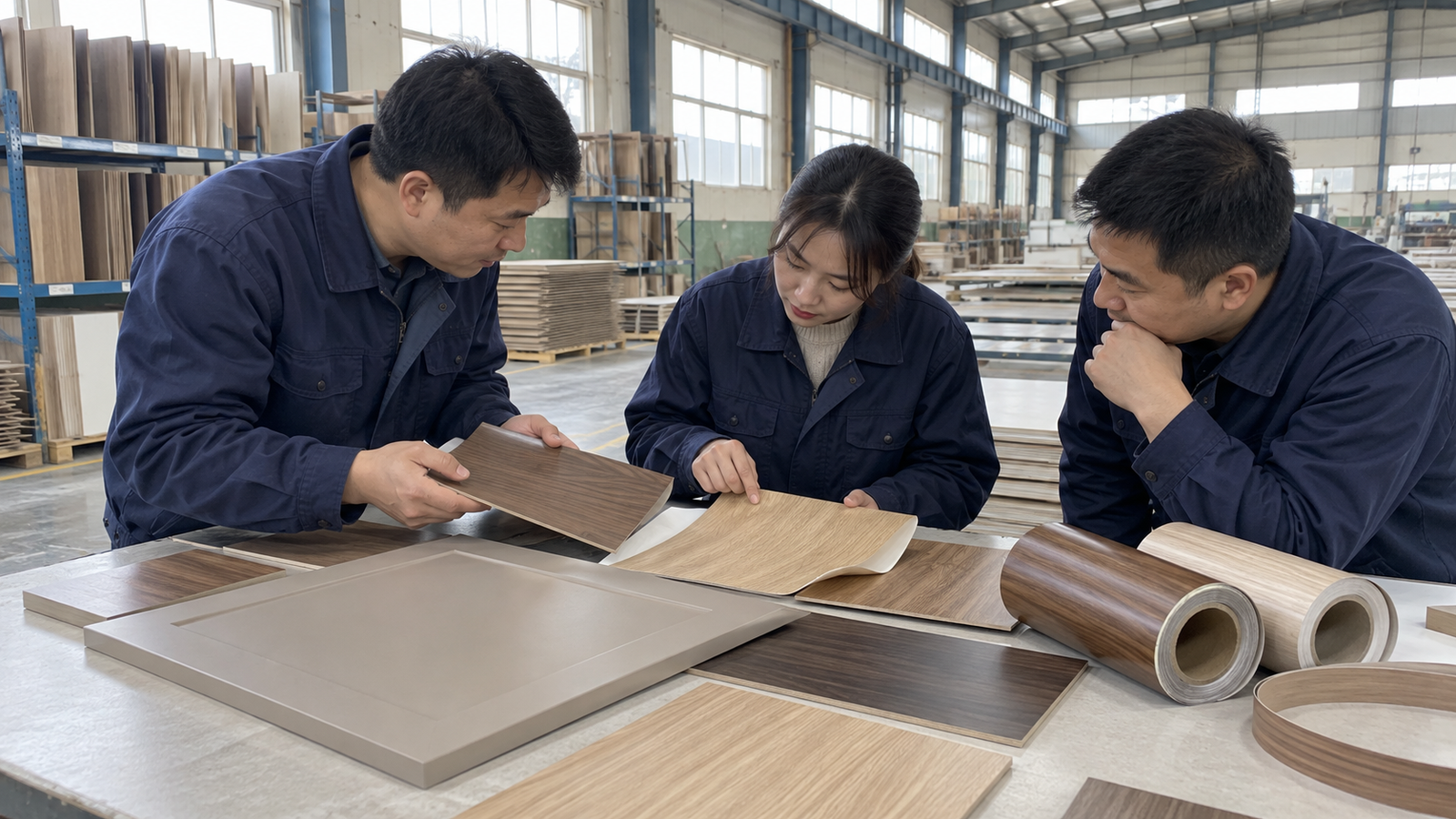
The first decorative film sample often wins attention through colour and touch. A convincing woodgrain or a soft matte finish can make a cabinet collection feel complete. For a production buyer, however, appearance is only the beginning of the decision.
The chosen film must also work with the substrate, adhesive, equipment and component geometry. It must remain acceptable after fabrication, handling and the agreed evaluation for its intended use. A film that looks excellent as a loose swatch may not be the right choice for a deeply routed door or a particular laminating line.
PET and PVC are both offered for decorative furniture surfaces. This guide explains how to compare specific products without relying on broad material rankings, and how to build an approval process that connects design with production.
The main buying principle: specify the finished component and manufacturing process first. Then compare suitable PET and PVC film grades using samples, documentation and a controlled trial.
1. Understand What You Are Actually Purchasing
PET stands for polyethylene terephthalate; PVC stands for polyvinyl chloride. These names identify polymer families. They do not describe every layer, coating, finish or processing characteristic of a decorative film product.
A purchasing specification should identify the exact film reference, decor, finish, thickness, roll format, intended process and recommended bonding system. Ask whether any temporary protective layer is included and whether quoted thickness includes that layer.
Industry offerings show why this distinction matters. RENOLIT’s interior surfaces brochure includes separate PET products for flat or two-dimensional work and for three-dimensional thermoforming, alongside PVC ranges with their own processing descriptions. The polymer name is therefore a starting point for selection, not a complete production instruction.
2. Begin with the Component Geometry
Make a list of the shapes your production line must cover. Separate flat cabinet fronts, routed doors, wrapped profiles, drawer parts and other components. Include drawings of important corners, grooves and edge transitions.
For a flat part, ask the supplier to confirm the proposed lamination route and any separate edge treatment. For a shaped part, provide the actual geometry and request confirmation that the proposed grade is intended for that forming process.
Avoid the assumption that PET is limited to flat surfaces or that every PVC film can handle any three-dimensional shape. The existence of a suitable product in a material family does not establish that another film from the same family will behave identically.
Choose a representative trial part with the details most likely to challenge the process. A simple flat rectangle cannot demonstrate how a routed recess or tight corner will look after forming.
3. Compare the Right Questions, Not Just the Polymer
| Selection question | What to ask for PET | What to ask for PVC |
|---|---|---|
| Is it intended for our process? | Exact grade and approved processing route | Exact grade and approved processing route |
| Will it cover our component shape? | Trial on the proposed geometry | Trial on the proposed geometry |
| How will the face look and feel? | Physical decor, gloss and texture sample | Physical decor, gloss and texture sample |
| How is performance demonstrated? | Product-specific test method and result | Product-specific test method and result |
| What bonding system is proposed? | Compatible adhesive, substrate and process instructions | Compatible adhesive, substrate and process instructions |
| How should price be evaluated? | Cost per accepted finished component | Cost per accepted finished component |
The table deliberately uses the same questions for both materials. That is how buyers can compare actual offers fairly while allowing different grades to meet different needs.
4. Match the Film to the Production Route
Flat lamination, profile wrapping and three-dimensional thermoforming are different operations. RENOLIT’s processing overview describes these routes and the role of suitable substrates, adhesives and equipment. Its descriptions also distinguish self-adhesive applications from industrial covering processes.
Before sampling, tell the supplier which equipment you use and how the component will be processed. Share the adhesive reference, substrate description, line arrangement and any important operating constraints. Ask for written guidance for the proposed film and adhesive combination.
If a supplier proposes a material substitution, review the process assumptions again. A film of similar colour and nominal thickness may still require a separate trial. Do not carry settings across simply because the replacement is described as PET or PVC.
Agree who will support the trial and who will record the result. Clear communication between the material supplier, adhesive supplier and production team is particularly useful when the cause of a defect is uncertain.
5. Inspect the Completed Surface, Including the Edge
Review colour, texture and gloss on a finished panel under the intended lighting. Compare the face with the matching edge material, adjoining panels and other finishes in the collection.
Pay attention to the parts customers will see together. A door, drawer front and filler panel may be made through different operations, so they should be reviewed as a set. For woodgrain, record direction and the desired relationship between neighbouring pieces.
A complete surface system may include more than the film. For example, REHAU’s RAUVISIO shade product page presents PET-faced panels together with coordinated edge options. This illustrates a useful buying habit: approve the face and edge as a finished combination. It does not mean other PET products share that branded system’s specifications.
Keep a signed master sample and record exactly which components it represents. If the final appearance depends on a particular substrate or production route, include that information in the approval record.
6. Turn Performance Labels into Testable Requirements
Terms such as “anti-scratch,” “anti-fingerprint” and “heat resistant” are not enough to compare two quotations. Ask for the test method, result, evaluated product and conditions. Decide which properties are necessary for the intended use before requesting a long list of unrelated claims.
For a cabinet front, the review may focus on appearance after routine contact and cleaning. A horizontal furniture surface may need a different evaluation. A component near an appliance deserves a discussion about the actual exposure and the completed assembly.
Avoid assigning a universal temperature limit or scratch ranking to PET or PVC. Ask for evidence covering the selected grade and clarify whether it concerns the loose film, a bonded panel or a finished component.
Create written acceptance criteria before the trial. “Looks good” leaves too much room for disagreement. Agreed lighting, viewing conditions, sample references and relevant tests make the decision easier to reproduce.
7. Run a Controlled Production Trial
A useful trial is designed to answer a defined question. Start by recording the film reference and batch, substrate, adhesive, component drawing and equipment settings. Use the same record for every candidate so the comparison remains meaningful.
Inspect representative parts after the required processing and conditioning sequence. Review corners, grooves, face appearance, edges and any locations where the trial team observed difficulty. Complete the agreed evaluations before releasing the material for the full order.
If the result is unsatisfactory, change one relevant variable at a time where practical. Replacing the film, adhesive and substrate together may produce a better part without explaining which change mattered.
The trial report should include:
- Exact material references and traceable batch details.
- Approved component drawing and substrate description.
- Adhesive and processing instructions used.
- Recorded machine settings and observations.
- Inspection or test results against agreed criteria.
- Photographs of important details and retained samples.
- A clear approval decision and any remaining conditions.
Once approved, communicate the specification to purchasing, production and quality control. Approval should be tied to an identifiable combination, not remembered as “the matte film we tried last month.”
8. Plan Roll Formats and Cutting Yield
Request roll width, usable width, length, winding orientation and identification details. Confirm how decor direction affects nesting or cutting, and whether your equipment imposes any roll-handling limits.
For woodgrain collections, consider whether adjacent components need a controlled visual relationship. Ask how that requirement affects material consumption and production sorting. For mixed designs, review changeovers and the amount of material needed for trials or setup.
Compare the total material required to produce the accepted components. A low price per square metre does not resolve an unsuitable width, difficult changeover or unexpected reject rate.
Discuss packaging and storage instructions before shipment. Make sure rolls can be identified on arrival and that production can distinguish approved material from trial or quarantined stock.
9. Request Environmental Information Precisely
If your customer asks about emissions, recycled content or material restrictions, convert the request into a specific documentation question. Identify the product and the evidence needed for that project.
Do not infer that a finished laminated board can enter a particular recycling stream merely because the loose film belongs to a familiar polymer family. Ask what the declaration covers: the film, adhesive, substrate or complete component, and whether an actual collection or recovery route has been identified.
Likewise, avoid treating a general environmental statement as a substitute for the documentation requested by a customer. Record the relevant product reference, report scope and conditions so the evidence can be reviewed alongside the purchase specification.
10. An Illustrative Cabinet Collection Brief
Imagine a buyer developing a collection with flat matte doors and woodgrain framed fronts. The initial brief should identify both shapes rather than request one generic film for the entire range.
The buyer can then shortlist suitable grades for each process, approve coordinated colours and edges, run the representative trials and compare the accepted-component cost. If one candidate works well on flat doors but fails the agreed evaluation on the framed front, that finding guides the specification for each component.
This is an example of a selection workflow, not a claim about a completed customer project. Its value is that it separates visual coordination from process approval without losing either requirement.
Frequently Asked Questions
Is PET decorative film always better than PVC?
No single material-family ranking can answer every application. Compare the specific grade, finish, process compatibility, documentation and completed-component results.
Can PET film be used for three-dimensional forming?
Suitable three-dimensional PET products exist. Confirm that the offered grade is designed for your process and geometry, then approve a representative trial. Do not assume all PET films share that capability.
Are all decorative films self-adhesive?
No. Industrial lamination and forming products may require a separate adhesive system. Specify the intended process and confirm the bonding instructions for the actual product.
What is the most useful sample to request?
Begin with a decor sample, then request or make a finished component using the intended substrate, adhesive, edges and geometry. A loose swatch supports visual selection but cannot answer every production question.
Source Decorative Films with Meifu Wood
Meifu Wood supplies PET and PVC decorative films alongside panels and other surface materials. Share your component drawings, finish references, production route and order requirements so we can discuss samples and suitable options for evaluation.
Explore our surface material range or contact Meifu Wood to discuss your film requirements.
