
Choosing a decorative panel starts with an appearance, but a successful purchase needs much more than the right woodgrain. The material must also suit the component, the fabrication process, the installation environment and the way the finished surface will be maintained.
HPL is often shortlisted for furniture, counters and interior fittings. Yet two quotations described as “HPL board” can cover different products. One may be for a decorative laminate sheet; another may include a substrate, a reverse-side finish and completed edges. Comparing their prices without checking the construction can lead to an expensive misunderstanding.
This guide explains how to turn a design idea into a clear HPL specification, evaluate samples and compare offers on a consistent basis.
The starting point: define the finished component first. Then agree on the surface grade, substrate, backing, edge treatment and acceptance criteria as one complete system.
1. What Is HPL?
HPL stands for high-pressure laminate. It is a decorative surfacing material made by consolidating resin-impregnated paper layers under heat and pressure. The decorative face provides the visible pattern, while the underlying layers form the laminate body. Thin HPL is normally bonded to a supporting panel. The Composite Panel Association’s HPL overview describes this construction and distinguishes general-purpose, postforming and specialist grades.
For a buyer, the useful distinction is between the surface material and the finished board. A woodgrain HPL face does not identify the core beneath it, the adhesive used to attach it or the construction on the reverse side. Each of those details belongs in the order specification.
Ask the supplier to describe the proposed product layer by layer. A simple section drawing or labelled sample edge can answer more questions than a page of general marketing claims.
2. Clarify What the Quotation Includes
Before comparing offers, place each one into the same supply category.
| Supply format | What the buyer receives | What to confirm |
|---|---|---|
| HPL sheet | Decorative laminate for further fabrication | Sheet dimensions, thickness, grade, finish and intended bonding process |
| HPL-faced panel | Laminate already bonded to a specified core | Core type, total thickness, reverse-side construction and flatness |
| Finished component | A panel processed for a particular installation | Cutting, drilling, edges, grain direction, drawings and packing sequence |
A quotation for loose laminate should not be compared directly with a quotation for a ready-to-install furniture component. Ask for a clear list of included operations, then identify which operations your own factory will still perform.
This approach also makes responsibility clearer. If the buyer will laminate the sheets locally, the initial trial should use the buyer’s own substrate and production process. If the supplier will deliver finished panels, the approved sample should represent that finished construction.
3. Describe the Application Before Choosing the Finish
“For furniture” is too broad to guide material selection. A wardrobe side, a café tabletop and a reception counter have different contact patterns and different visual priorities.
Prepare a short application brief covering the component location, whether it is horizontal or vertical, expected contact, nearby appliances, likely spills and cleaning routine. Add a photograph or drawing showing edges, joints, supports and openings.
For a retail display, the main concern might be how the surface looks under directional lighting. For restaurant furniture, the sample review might focus on repeated wiping and visible edge details. For wall cladding, the joint layout and the relationship between adjacent woodgrain panels may deserve more attention.
Treat these as questions for the specific grade and assembly. A broad statement such as “durable HPL” cannot replace an agreed performance requirement.
4. Evaluate Colour, Texture and Grain at a Useful Scale
Small colour chips help create a shortlist. They are less useful for judging a full-height cabinet door or a long counter front. Request a larger sample when pattern scale or directional grain will strongly influence the design.
Review shortlisted finishes in daylight and under the lighting planned for the installation. Place the sample beside the flooring, metalwork, paint and other materials that will surround it. A finish approved in isolation may look different once those elements are combined.
For woodgrain designs, agree on the direction for every visible component. If a drawing shows horizontal grain on drawer fronts and vertical grain on tall doors, record that instruction explicitly. Do not leave the cutting team to infer it from a rendered room image.
Keep an approved physical master sample with its product code and finish reference. Photographs are useful for communication, but camera settings and screens make them a weak substitute for final colour approval.
5. Review the Substrate, Backing and Edges Together
The reverse side is easy to overlook because it is absent from most product photographs. It still belongs in the specification. The Composite Panel Association’s dimensional stability bulletin explains how moisture changes and unbalanced panel constructions can contribute to movement and warping.
Ask what backing is proposed, why it suits the component and how the completed panel will be checked for flatness. Do this before production approval, particularly for large doors, long panels or components that will be stored before installation.
Next, review the edges. Specify whether they will be supplied unfinished, banded, profiled or otherwise completed. Confirm the visible colour match, corner detail and treatment of cut-outs. A pleasing face sample does not demonstrate how a sink opening, cable hole or exposed corner will be finished.
Request a representative component that includes at least one finished edge and any important machining detail. This gives the design and production teams a shared reference.
6. Replace Broad Performance Claims with Evidence
Scratch resistance, wear resistance, stain resistance and heat resistance describe different behaviours. Ask which property matters for your application, which test method is relevant and whether the evidence covers the proposed grade.
Special applications deserve specific documentation. If a project calls for a fire classification or chemical resistance, ask for the applicable report and check the tested product, thickness, substrate and installation conditions. The word “HPL” alone does not establish those properties.
Also review care requirements early. For example, Formica’s laminate care guidance recommends protecting its laminate surfaces from sharp utensils and excessive heat and using appropriate non-abrasive cleaning methods. This is a useful reminder to obtain the care instructions for the actual product being purchased, rather than assume any decorative laminate is maintenance-free.
Include those instructions in the handover information for your installer or customer.
7. Use a Three-Stage Sample Approval Process
Stage one: visual approval. Select the colour, texture, gloss and pattern direction. Record the approved references and identify the person authorised to sign off changes.
Stage two: fabrication approval. Produce a representative component using the intended core, adhesive, backing, edge and machining sequence. Inspect the completed result from normal viewing positions as well as close up.
Stage three: order approval. Confirm that the production specification matches the approved component. Attach drawings, sample references, agreed tolerances, inspection arrangements and packaging requirements to the purchase documentation.
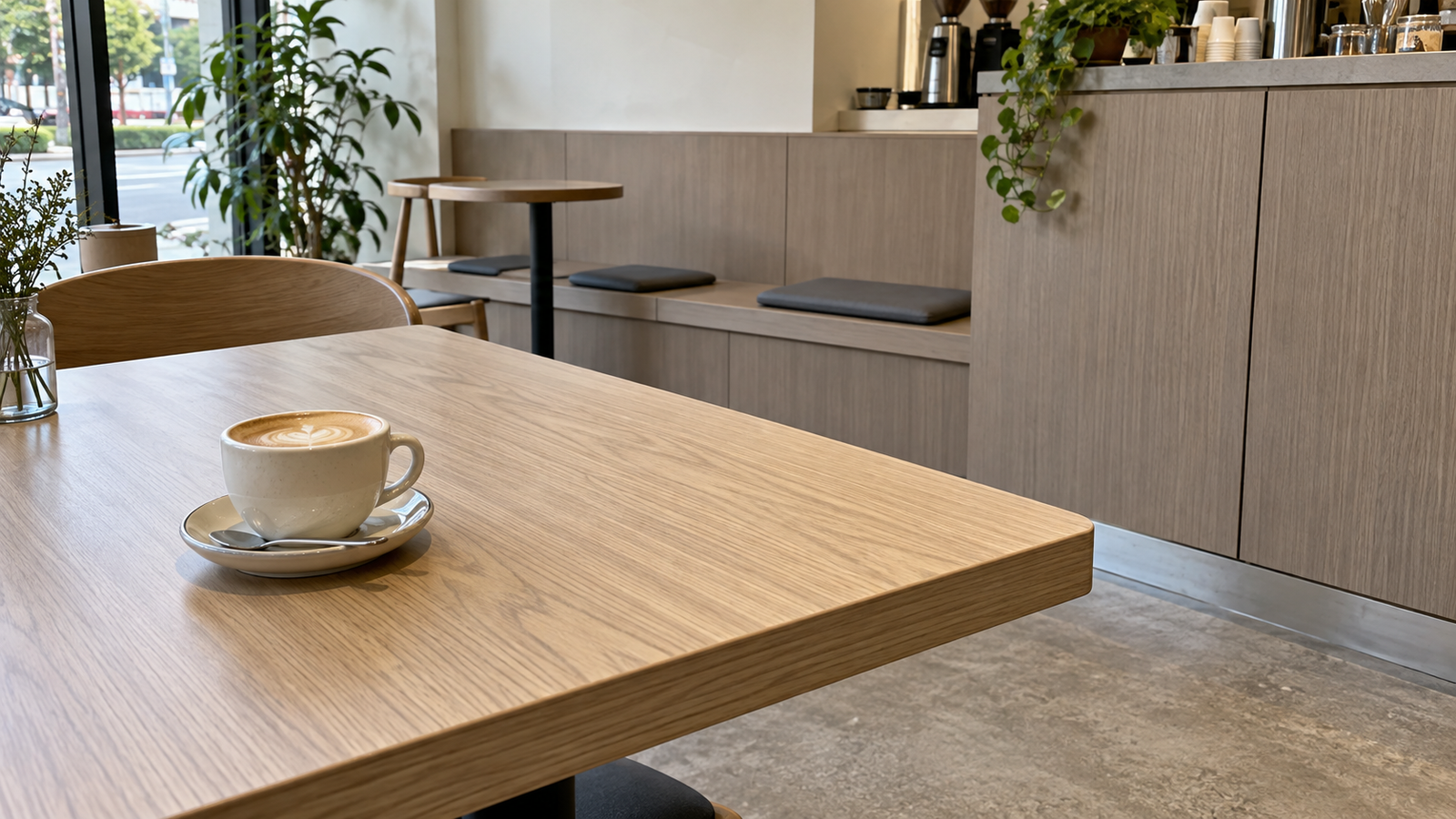
For an illustrative café project, this might mean approving the oak decor first, evaluating one completed tabletop next and then checking the final cutting and packing schedule. The sequence makes each decision manageable and reduces the chance of discovering an edge detail problem after the full order is produced.
8. Compare Cost per Accepted Component
A lower sheet price may be attractive, but procurement should also account for cutting yield, fabrication, packaging, freight and rejected components.
Ask each supplier to quote against the same dimensions and construction. Check whether grain direction changes the cutting plan. Identify whether protective film, edge treatment, pallet protection and mixed-size sorting are included. Record these details alongside the unit price.
For repeat programmes, discuss how decor references, approved samples and order records will be maintained. Agree on how a future substitution will be reviewed. A material that requires another approval cycle can affect the schedule even when its purchase price is similar.
9. HPL Enquiry Checklist
Send the following information with your request:
- Component use and installation environment.
- Drawings, finished dimensions and grain direction.
- Required supply format: sheets, faced panels or finished parts.
- Surface design, texture, grade and sample reference.
- Core, backing, edge treatment and machining requirements.
- Relevant performance documentation and acceptance criteria.
- Order quantity, destination, packaging needs and target schedule.
Where a detail is undecided, flag it as a question. This is more useful than inserting an assumed specification that later has to be changed.
Frequently Asked Questions
Is an HPL sheet the same as an HPL-faced board?
No. The sheet is the surfacing material. An HPL-faced board includes a supporting core and may also include backing, edging and other processing. Confirm the complete construction before comparing prices.
Can every HPL grade be formed around curved edges?
Do not assume so. Postforming requires a suitable grade and a compatible fabrication process. Share the proposed profile with the supplier and approve a trial component before ordering.
Can a colour code replace a physical sample?
A code identifies the intended decor, but a physical sample is a stronger basis for visual approval. Use both, especially when coordinating several materials or planning repeat orders.
What should I send when requesting samples?
Include the application, preferred design, component dimensions and intended supply format. If bonding or machining will take place in your factory, describe that process so the trial material can be selected appropriately.
Plan Your Next HPL Order with Meifu Wood
Meifu Wood supplies decorative panels and matching surface materials for furniture manufacturers, interior projects and building material distributors. Share your application, drawings and finish references so we can discuss suitable supply options, samples and packaging requirements.
Explore our product range or contact Meifu Wood about your project.
